
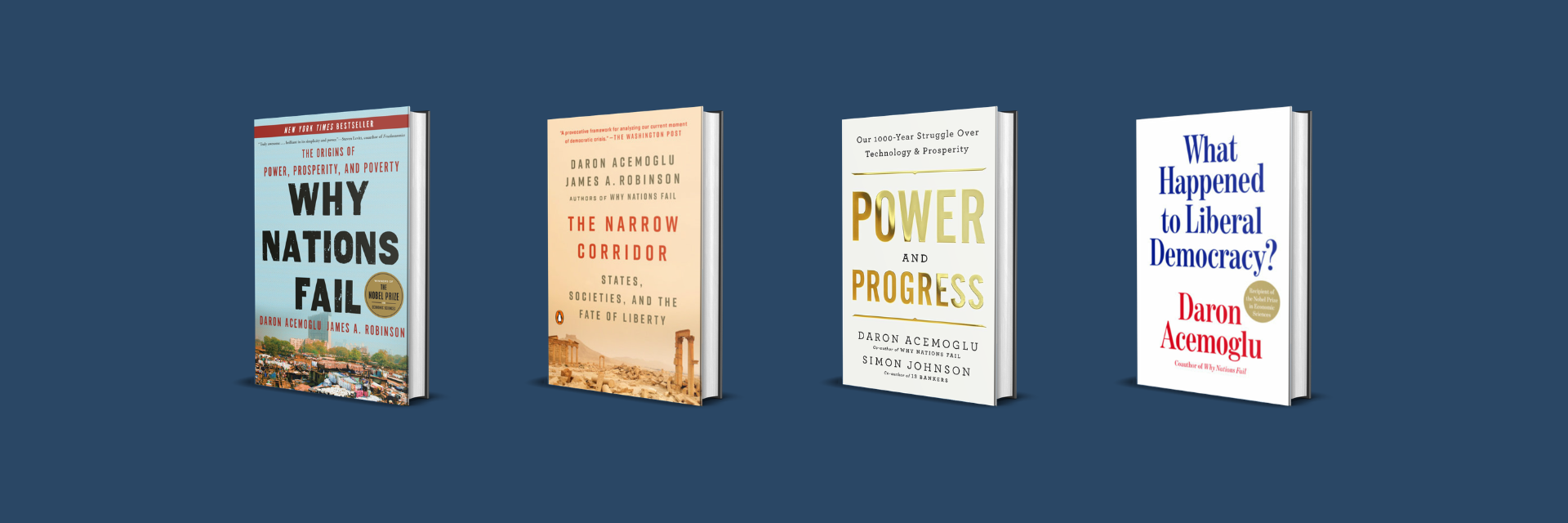
Daron Acemoglu is the author of What Happened to Liberal Democracy?, as well as the New York Times bestselling co-author of Why Nations Fail, The Narrow Corridor, and Power and Progress.
What Happened to Liberal Democracy? (2026)
Remaking a Politics of Shared Prosperity
From Daron Acemoglu, 2024 Nobel laureate in economics and coauthor of Why Nations Fail, an ambitious and expansive inquiry into the biggest story in global politics over the last hundred years: the rise and fall of liberal democracy.
A very important work and a must-read.
Thomas Piketty, #1 New York Times bestselling author of Capital in the Twenty-First CenturyThe dissolution of the Soviet Union in 1991 raised hopes that we were one step closer to the triumph of liberalism. Soon, many predicted, we would all be living in functional liberal democracies. Sustained economic growth would benefit all segments of society and war would be a relic of the past. A generation later, one can only ask: What happened?
Nobel laureate Daron Acemoglu argues in this powerful book that liberal democracy flourished when it pursued its core promises of shared prosperity, democratic governance, and the free pursuit of knowledge. But liberalism, a philosophy built to challenge power, never fully adjusted to becoming the establishment. Nor was it able to deal with the economic and social disruptions that digital technologies wrought. Worse, in the postindustrial economy, liberalism turned its back on its core promises. As a segment of college-educated elites became politically dominant and separated from the rest of society, they sowed the seeds of widespread inequality while intensifying efforts to reshape mass culture and values.
Acemoglu, using the wide interdisciplinary lens that has won him acclaim, documents the extraordinary, unparalleled progress that liberalism created, and recounts how liberal democratic institutions plunged themselves into crisis over the last several decades. Looking at rapid advances in technology, shifts in regulatory environments, global political history, and economics, Acemoglu lucidly lays out the successes and failures of our most important political system. And he envisions a new way forward, which he calls working-class liberalism: a philosophy that prioritizes shared prosperity, empowers communities, and accommodates a range of values and views.

Power and Progress (2024)
Our Thousand-Year Struggle Over Technology and Prosperity
Awarded the 2024 Nobel Prize in Economics, Daron Acemoglu and Simon Johnson overturn conventional wisdom about how economies work–revealing the untold story of who wins and who loses the rewards of prosperity–in a work that fundamentally transforms how we look at and understand the world.
The blueprint we need for the challenges ahead.
Shoshana Zuboff, New York Times bestselling author of The Age of Surveillance CapitalismThroughout history, technological change — whether it takes the form of agricultural improvements in the Middle Ages, the Industrial Revolution, or today’s artificial intelligence — has been viewed as a main driver of prosperity, working in the public interest. The reality, though, is that technology is shaped by what powerful people want and believe, generating riches, social respect, cultural prominence, and further political voice for those already powerful. For most of the rest of us, there is the illusion of progress.
Daron Acemoglu and Simon Johnson debunk modern techno-optimism through a dazzling, original account of how technological choices have changed the course of history. From vivid stories of how the economic surplus of the Middle Ages was appropriated by an ecclesiastical elite to build cathedrals while the peasants starved, to the making of vast fortunes from digital technologies today as millions are pushed towards poverty, we see how the path of technology is determined and who influences its trajectory.
To achieve the true potential of innovation, we need to ensure technology is creating new jobs and opportunities rather than marginalizing most people, through automated work and political passivity. We need to use the tremendous digital advances of the last half century to create useful and empowering tools, and seize back control from a small elite of hubristic, messianic tech leaders pursuing their own interests.
With their breakthrough economic theory and manifesto for building a better society, Acemoglu and Johnson provide the understanding and vision to reimagine and reshape the path of technology and create true shared prosperity.
The Narrow Corridor (2020)
States, Societies, and the Fate of Liberty
From the winners of the 2024 Nobel Prize for Economics and the authors of the international bestseller Why Nations Fail
A work of staggering ambition—aiming to explain why liberty has or has not existed at every moment in time in every geography in the world. Smart and timely.
NewsweekIn Why Nations Fail, Daron Acemoglu and James A. Robinson argued that countries rise and fall based not on culture, geography, or chance, but on the power of their institutions. In their new book, they build a new theory about liberty and how to achieve it, drawing a wealth of evidence from both current affairs and disparate threads of world history.
Liberty is hardly the “natural” order of things. In most places and at most times, the strong have dominated the weak and human freedom has been quashed by force or by customs and norms. Either states have been too weak to protect individuals from these threats, or states have been too strong for people to protect themselves from despotism. Liberty emerges only when a delicate and precarious balance is struck between state and society.
There is a Western myth that political liberty is a durable construct, arrived at by a process of “enlightenment.” This static view is a fantasy, the authors argue. In reality, the corridor to liberty is narrow and stays open only via a fundamental and incessant struggle between state and society: The authors look to the American Civil Rights Movement, Europe’s early and recent history, the Zapotec civilization circa 500 BCE, and Lagos’s efforts to uproot corruption and institute government accountability to illustrate what it takes to get and stay in the corridor. But they also examine Chinese imperial history, colonialism in the Pacific, India’s caste system, Saudi Arabia’s suffocating cage of norms, and the “Paper Leviathan” of many Latin American and African nations to show how countries can drift away from it, and explain the feedback loops that make liberty harder to achieve.
Today we are in the midst of a time of wrenching destabilization. We need liberty more than ever, and yet the corridor to liberty is becoming narrower and more treacherous. The danger on the horizon is not “just” the loss of our political freedom, however grim that is in itself; it is also the disintegration of the prosperity and safety that critically depend on liberty. The opposite of the corridor of liberty is the road to ruin.

Why Nations Fail (2013)
The Origins of Power, Prosperity, and Poverty
NEW YORK TIMES AND WALL STREET JOURNAL BESTSELLER • From two winners of the 2024 Nobel Prize in Economic Sciences, “who have demonstrated the importance of societal institutions for a country’s prosperity”
Bracing, garrulous, wildly ambitious and ultimately hopeful. It may, in fact, be a bit of a masterpiece.
The Washington PostWhy are some nations rich and others poor, divided by wealth and poverty, health and sickness, food and famine? Is it culture, the weather, or geography that determines prosperity or poverty? As Why Nations Fail shows, none of these factors is either definitive or destiny.
Drawing on fifteen years of original research, Daron Acemoglu and James Robinson conclusively show that it is our man-made political and economic institutions that underlie economic success (or the lack of it). Korea, to take just one example, is a remarkably homogenous nation, yet the people of North Korea are among the poorest on earth while their brothers and sisters in South Korea are among the richest. The differences between the Koreas is due to the politics that created those two different institutional trajectories. Acemoglu and Robinson marshal extraordinary historical evidence from the Roman Empire, the Mayan city-states, the Soviet Union, the United States, and Africa to build a new theory of political economy with great relevance for the big questions of today.